
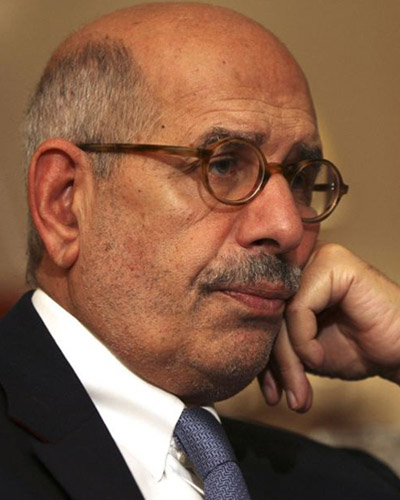
Dr Mohamed ElBaradei
Nobel Peace Laureate, Director General Emeritus of International Atomic Energy Agency
War has been with us since recorded history and so were the innumerable efforts from diverse cultures all around the world to abolish it or restrict its use and limit its impact. These efforts anchored in religious and moral restraints and specific treaties spanned the common era all the way to the modern UN system. Humans had understood from the earliest times that war should not be the basis for settling disputes and yearned for a peaceful replacement. Yet throughout the centuries humanity failed its aspirations. What is making things even more horrific now is that our failure persists at a time when the nature of war is dramatically changing making the prospect of global annihilation a real possibility. The question of whether and how we can put an end to war, posed by Einstein to Freud in 1932 – before Hiroshima and Nagasaki- has therefore become a compelling existential question.
I refuse to believe that, with the incredible strides' humanity has made in understanding our planet and ourselves and the phenomenal leaps in science and technology, we cannot find a better way to live together in peace and dignity. Below are a few steps that we need to take in tandem to achieve a change of mindset that overtime would make war a relic of the past. There is no silver bullet.
First, a global expansion of democratic institutions where the decision to launch a war is collective and does not rest with a single person or a handful of oligarchs. And putting in place robust guardrails to protect democracies from sliding into dictatorships.
Second, a universal educational system that equips us to grasp that our common humanity is what binds us and to understand that our differences in terms of religion, culture, ethnicity, language etc. are superficial and that diversity is our strength; we, like a tree, have different branches but we share the same root.
Third, a concrete and time bound program of general and complete disarmament starting with nuclear and other weapons of mass destruction, in parallel with the establishment of an equitable and inclusive system of collective security.
Fourth, a universally binding judicial system that any party to a conflict or dispute can invoke, in addition to other effective mechanisms for the peaceful settlement of disputes.
Fifth, a global economic and financial system rooted in equality and fairness and ensuring human dignity for all. No human should be left behind.
Sixth, forums for ongoing dialogue between people of distinct cultures and backgrounds to experience firsthand that we are all one human family irrespective of our superficial differences and that we are all “our brothers' keepers”.
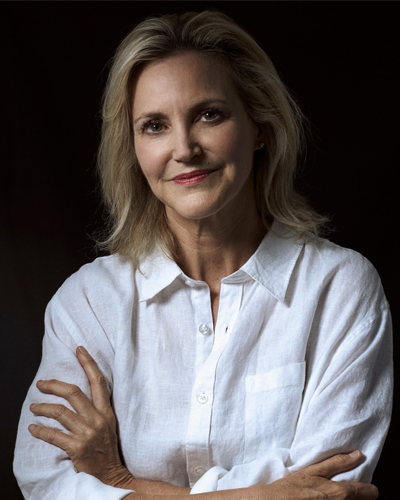
Melissa Parke
Executive Director of the International Campaign to Abolish Nuclear Weapons (ICAN is recipient of institutional Nobel Peace Prize)
The UN was established to ‘save succeeding generations from the scourge of war’. Yet, we find ourselves 80 years later closer to global war than we have been in decades. A global war in the nuclear age will likely bring about the end of all complex life on earth.
As I just witnessed at the 2026 Munich Security Conference, the hawkish politicians, military planners, arms manufacturers, conservative think tankers (more tank than think) and defence journalists advocating confrontation, militarisation and nuclear weapons proliferation live in an elite echo chamber where nuclear deterrence has been elevated from a theory to a cult-like ideology, and its failure can never be contemplated. Yet the supposedly responsible management of genocidal capability has always been an illusion.
We know nuclear deterrence has failed many times in the past, and humanity has survived only due to luck or an individual’s restraint. The so-called ‘modernisation’ of nuclear weapons, which is compressing decision times and increasing ambiguity, makes a catastrophic failure more likely. It also signals the normalisation of perpetual nuclear threat and the diversion of vast resources from constructive potential to destructive capacity, a grave injustice against current and future generations.
Fortunately, the pro-deterrence view is a minority view. Because of powerful voices of people at the frontlines across the globe, we now have a Treaty in the UN that bans nuclear weapons, that provides a pathway under international law for nuclear armed states to disarm in a timebound verifiable manner, and that will support communities and environments harmed by nuclear weapons.
More than half the world's governments have signed the Treaty on the Prohibition of Nuclear Weapons (TPNW) and more are joining in the near future. War is not inevitable. It is a choice.
Author Yuval Noah Harari talks about the power of human imagination to redirect our ingenuity from self-destruction to self-creation. The TPNW is an example of such self-creation, where most nations are choosing dialogue over confrontation, diplomacy over militarisation and disarmament over proliferation. This is the opportunity for humanity to avoid self-destruction and create a new future that respects the earth and each other.
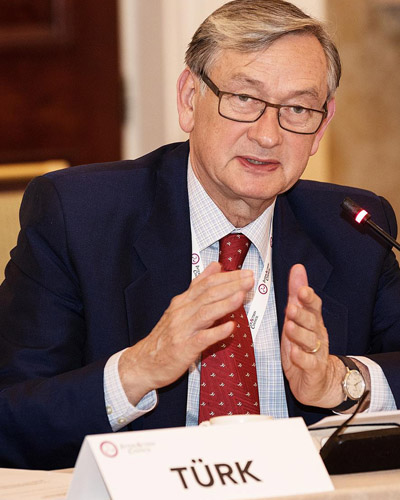
Danilo Turk
Former President of Slovenia and former Assistant Secretary General of the United Nations
The question about "a way of delivering" invites analogy. For example, "every long march starts with the first step". The emphasis is on the long march but with recognition of the importance of the first step.
So, what is the first step? In my opinion it is necessary to reject any notion of inevitability of war as the first step towards the task of "delivering" humankind from the menace of war. Then, "delivering from the menace" entails a wide variety of activities calculated to prevent wars. Some of them are institutional - like the United Nations. But institutions per se do not guarantee success. They have to be taken seriously and led wisely. That, in turn, will depend on the wisdom of those who hold most power. There is no substitute for great powers. That was fundamental in history and remains fundamental in our era.
To me, the idea of "delivering humankind from the menace of war" sounds like a process, not a single act. Moreover, this is a complex process requiring engagement of many actors, starting, as said, with great powers. In our era, special effort needs to be made to harness technology, including information technologies for the purpose of delivering humankind from the menace of war. Artificial Intelligence should serve that purpose.
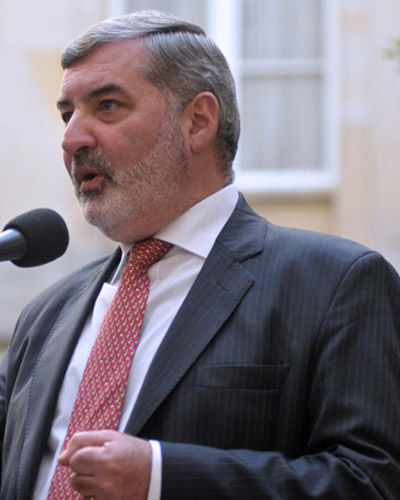
Lord Alderdice, John
Former Speaker of the Northern Ireland Parliament, Senior Fellow at Harris Manchester College of Oxford University
War arises when one group seeks to impose its wishes on another by force of arms, and the group that is attacked responds in kind. This dynamic has always been a characteristic of relationships between human groups. All efforts to remove the threat of war have ultimately failed – whether through deterrence because of the many costs, negotiation of disarmament treaties, establishment of a rules-based order, or the education of leaders and people about its potentially catastrophic consequences.
Some causes are intrinsic to human nature, for example, revenge for past hurts, greed for the possessions of the others, rivalry, the wish to dominate, and the pleasure and satisfaction afforded by such behaviours. War is not informed only by rational cost-benefit calculation but is heavily driven by emotional factors including the sense of identity and confidence that a community has in itself. In so far as war is an outcome of such intrinsic human characteristics, it seems almost certain that while individual wars can be ended, (and ultimately, they all come to an end) removing the phenomenon of war from the catalogue of potential human behaviours does not seem possible.
However, in so far as war is a consequence of a breakdown in the relationships between communities of people, the focus should be on understanding and addressing these disturbed relationships rather than solely on rules, regulations and resources. Relationships are complex, organic phenomena which cannot be permanently ‘fixed’ and so while attempts to end individual wars may be successful, and focussing on relationships can help prevent future conflicts, it is not possible to remove the human potential for war, which is the greatest threat to the survival of humanity and its civilization.
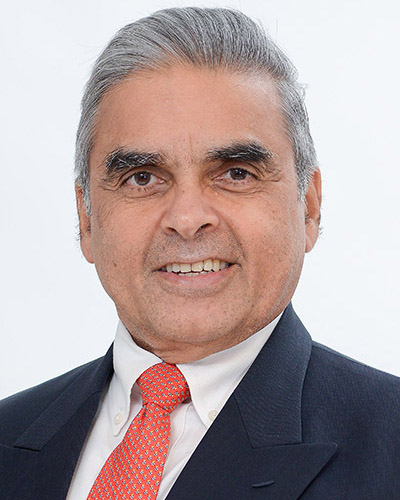
Kishore Mahbubani
Founding Dean of the Lee Kuan Yew School of Public Policy, former Singaporean Ambassador to the United Nations
Yes, we can get rid of the menace of war. The European Union (EU) has done it. Since the creation of the EU in 1993, there have been zero wars between any of the EU member states. Even more amazingly, there have been zero prospects of war among them.
What makes the achievement of zero prospects of war truly amazing is that no other region has replicated it. Yet, despite this achievement, it doesn’t mean that Europeans are inherently peaceful. They continued to fight wars in other continents (as in Iraq, Libya, Afghanistan and Syria). More disastrously, they even indulged in proxy wars with each other in the Yugoslav conflicts of the 1990s. In the current Ukraine war, the EU states portray themselves as the defenders of the innocent Ukrainian victims of Russian aggression. Yet many in the Global South believe that the Europeans may have indirectly provoked the war by threatening to pull Ukraine into NATO with the famous 2008 NATO announcement saying Ukraine could join. In short, we live in a world of moral and geopolitical complexity which will make the abolition of wars almost impossible.
In theory, the common danger of climate change wrecking our fragile planetary ecosystem should have brought humankind together. Sadly, it hasn’t. Immediate geopolitical challenges trump long‑term planetary threats. That is why the wars in Ukraine and Gaza rage on, even though in both cases simple common‑sense compromise solutions could be found.
One big tragedy of the human condition is that common sense is not common. When nations like Israel and Palestine, Ukraine and Russia, India and Pakistan, or Thailand and Cambodia should cooperate for mutual benefit, they don’t. Each state can recite a long litany of reasons why cooperation isn’t possible. Does this mean there is no hope for peace?
There’s no hope for a perfect peace. But there’s hope for an imperfect peace. ASEAN shows the way. Unlike the EU, there have been skirmishes between ASEAN member states, as in the recent clashes between Thailand and Cambodia. Yet, amazingly, even though the ASEAN region is the most diverse region on planet Earth (with greater diversity of race, language, religion and culture than any other region), there have been no major wars between any ASEAN states since its creation in 1967.
How did ASEAN achieve this? The founding leaders of ASEAN had created an ecosystem of peace in Southeast Asia by slowly and steadily expanding networks of cooperation in a vast range of areas, from trade and economic integration; maintaining financial market stability; tourism; people-to-people connectivity; human development; agriculture and forestry; sustainability; energy infrastructure; science, technology and innovation; developing a digital economy; defence; food security; counterterrorism; and disaster management. As a result, thousands of face‑to‑face meetings take place each year between ASEAN officials.
I have participated in dozens of ASEAN meetings. I saw with my own eyes how traditional historical distrust between hostile neighbours evaporated as we interacted as human beings in a common setting. Playing golf together helped. Over time, decades of meetings have generated several concentric circles of cooperation which have significantly reduced the prospects of war. In short, an imperfect peace is possible on planet Earth. ASEAN shows how!

Jody Williams
Nobel Peace Laureate, Chairperson of Nobel Women’s Initiative
There are moments when the question of war does not present itself as an intellectual puzzle, but as a weight on the mind; restless, insistent, impossible to set aside. The difficulty is not merely in answering, but in believing any answer one might give.
We live in a time shaped, visibly and unapologetically, by men who seem to draw energy from domination, grievance, and spectacle. Their words distort truth; their ambitions stretch across borders; their decisions carry the quiet consent of systems that reward power more readily than they restrain it. They are not alone, nor entirely new, but their convergence in this moment sharpens the sense that we are watching not isolated failures, but a pattern repeating itself with renewed force.
Faced with this, the mind searches for escape routes including some earnest, some absurd. At times, the imagination drifts toward impossible remedies, as if only the fantastical could match the scale of the problem. I wish we could neutralize aggression at its biological roots, to outgrow the very impulses that have accompanied human history. Such thoughts dissolve almost as soon as they arise. They are less proposals than expressions of fatigue.
It would be comforting to believe that the answer lies simply in replacing one kind of leadership with another. If women held power, the architecture of war would soften or disappear. Yet history resists such easy conclusions. Women, too, have led nations into conflict. And yet, there remains a quiet intuition which is difficult to prove, but difficult to dismiss. The world less dominated by the performance of power might be a world less drawn to its most violent expressions.
It would be comforting to believe that the answer lies simply in replacing one kind of leadership with another. If women held power, the architecture of war would soften or disappear. Yet history resists such easy conclusions. Women, too, have led nations into conflict. And yet, there remains a quiet intuition which is difficult to prove, but difficult to dismiss. The world less dominated by the performance of power might be a world less drawn to its most violent expressions.
What unsettles me most is not only the persistence of war, but the normalization of its language and incentives. Violence is discussed as strategy, and profit as justification. The machinery of war is no longer hidden; it is advertised, invested in, and admired. Against such a backdrop, the aspiration to end war can begin to feel almost naïve, as though it belongs to a different moral universe.
And yet, to abandon the question would be a deeper failure.
Perhaps the real challenge is not that we lack ideas for peace, but that we lack the collective will to choose them over a mindset of power, profit, and pride. To end war would require not a single solution, but a transformation of values, of incentives, of what we admire and what we refuse to tolerate.
I do not know if such a transformation is within our reach. Some days, it feels impossibly distant. But the act of asking the question - honestly, persistently, even in confusion - is itself a refusal to accept war as inevitable.
13 Responses
Humanity’s greatest breakthroughs emerge not from centralized power, but from decentralized networks of trust operating beneath prevailing paradigms. To wit:
Slavery — millennia old — was largely abolished in 180 years. Women’s enfranchisement, foundational to peace, is barely a century old. Smallpox — killing millions — was eradicated by scientists working across the Cold War divide at its very height.
These shifts seemed impossible. Then they weren’t. Ignorance persists. Until it doesn’t.
– David Judson, journalist and aspiring wayfinder
As long as pride, selfishness, anger, and the thirst for power prevail—along with the will to dominate others in the name of a supposed humanity—we will remain trapped in a flawed model that seeks to build peace through war. Only active listening, dialogue, mediation, and education grounded in morality, equality, and the value of human life can reverse this destructive logic.
– Alexandra Monné, professor and aspiring to work for the concord of humanity
Dialogue and diplomacy are, in fact, the true effective weapons against war. The image of the first step highlights the necessity of shared responsibility while firmly rejecting the idea that war is inevitable. The causes of war are primarily human. Understanding human relationships is essential to preventing conflicts. Reflecting on European history remains imperative. The example of ASEAN, with its diversity and stability, inspires confidence. The experience of renewed meetings between leaders shows that peace, even if imperfect, rests on human relationships. The fight for peace is difficult, as violence has become a strategy. Yet, refusing to give in despite obstacles remains a hallmark of our shared humanity.
War is unlikely to disappear. It is the extreme of a broader conflict continuum. The question is not abolition, but mitigation: making wars rarer, shorter, less intense, and costlier for those who promote and sustain them. Many responses emphasize aspiration over operational design. The missing piece is enforceable constraint. AI may give smaller powers new capacity to expose real costs and constrain escalation.
Roman Khimich, independent researcher in conflict and governance
The proper application of artificial intelligence technologies will help us mitigate the risks of war. As we have witnessed in Ukraine, Palestine, and Iran, AI is highly prone to committing grave errors—errors so complex that humans may not even know how to intervene. Driven by fierce technological competition, the risks of AI spiraling out of control and being misused are escalating further. Autonomous weapon systems are rapidly proliferating across the globe. Algorithms are manipulating the perceptions of both policymakers and the general public, thereby fueling even broader political polarization, hatred, and violence. Sci-fi scenarios—such as machines that kill and the rise of “Terminators”—are fast becoming reality.
Tianjiao Jiang, associate professor of Fudan University
We live in an era of both heightened danger but at the same time an era of revolution. This is the era of artificial intelligence which may enhance the destruction of humankind or help to save it. I noted that only Danil Tusk specifically addressed how AI should serve the purpose of delivering humankind from war. I think for our purposes here we can ignore generative AI but agentic AI may be the saviour or the curse. Anthropic is now suing the US Government to prevent the Pentagon from using the agentic AI ( Claude) in autonomous weapons. In late 2025 it was discovered that the anthropic AI had without more than 10% human input, orchestrated a cyber espionage campaign. Thus we already have an era of AI threats. The young who understand the way this new revolution is shaping up, can be the ones who can shape it for the common good.
Like Kishore Mahbubani outlined, there is hope for certain groupings – the EU ( of which two are nuclear aarmed states) and ASEAN to lead the way in peaceful coexistence. In 1995 the Bangkok Treaty was signed prohibiiting members from developing or holding nuclear weapons. In July 2025 China indicated it would sign the protocol to respect this zone. All is not lost if we use these tools to reshape the path we are on.
Greg Crichton
Financial Services executive
Since Aeschilus, the question has no answer. And compared to Einstein, Aeschilus, like Socrates or Dante, had been a soldier, he knew the military logic from inside. War seems to be able to be eradicated only through self-consumption. Since few decades, we see no war capable to end with a lasting military victory (perhaps the last one was the Sri Lankan army crackdown on LTTE): Russia on Ukraine, Israel against Hamas or Hezbollah, Iran, Iraq, Libya, Afghanistan, Sudan, Congo, etc.: it is easy to start a war, and then it goes nowhere. Perhaps warriors will realize that a war is a pointless exercise – profitable for few but overall costly and ineffective.
However, Machiavelli, always so lucid, warned that “the war cannot be stopped, only moved somewhere else and transformed for someone else’s convenience”. And today’s war is being modified in several ways: AI slavery, control of data base, cyber attacks, media manipulation, social networks dependency… Less bloody but still war, and again any appeal to reason seems doomed to failure. Therefore, I believe that the final round will not be between pro-peace thinkers and militants and warriors, but between warriors and former warriors. Eventually, this is the legacy of the European Union, the project of a soft power that, after thousands of years of powerful armies faced by two total devastations, yes, within its own territory, has been able to abolish war.
War reflects a deep human condition – the enduring struggle between good and evil, expressed differently across cultures, religions, and political systems. We cannot eliminate conflict entirely, but we can learn to manage it. That requires discipline, moral leadership, strong institutional frameworks, and acceptance of difficult trade-offs. By grounding ourselves in shared values, taking responsibility for one another and our planet, and investing in diplomacy, we can rebuild what unites us and better contain what divides us. Eva Grosman, Centre for Democracy and Peace
No, is the short and sad answer to this question. However we as humans need hope to survive and develop. As long as violence, rape, prejudice and greed exists we will not evolve enough as a species to deliver ourselves from war. Even within the same most peaceful and loving communities misunderstandings or righteousness will occur from time to time, the difference is in how to solve the issues. Through a positive and loving mindset or a vengeful and suspicious look on life. We need to chose to evolve, and for this we need introspection and personality development. I think the list of the steps needed as proposed by Dr Mohamed ElBaradei, was very insightful. However, we as humans, have not even in the most advanced democratic societies come much further than step number three or four with an international abolishment of weapons of mass destruction and a globally respected and binding judicial system, which with every war sadly goes backward and with every election seems a little bit further away from our grasp. I don’t know if we are going backwards or forward right now, but the future certainly looks more intense. As food and water supply will become our biggest problem to solve in the future, more conflicts are to come.
Wars are rooted in insecurity—especially the fear of exclusion from power—but today this insecurity is deliberately weaponized. Globalization’s failures are recast as cultural threats, fuelling nationalism that masks leadership incompetence and sustains elite control. The result is a permanent war ecology—spanning cyber, financial, and soon space domains—where public fear is traded for political authority. War, then, is no longer episodic but systemic. Delivering humankind from it demands more than treaties; it requires an alert, politically conscious citizenry that refuses manufactured insecurity and reclaims the narrative from those who profit from perpetual conflict
Well said.
Wars have been fought from the dawn of civilisation! The reasons for getting involved in a war have been discussed by notable thinkers. Common man from warring countries never want a enter into a conflict. As past President of the International Association of Rural Health and Medicine, I worked in many rural communities around the world and nobody ever wanted to have a war. In any given war, it’s the common poor man,especially women and children who suffers most. The Economic loss coupled with traumatic experiences leads to human suffering and migration.
In fact, almost all the wars have been started by leaders, who mostly come in the disguise of democratically elected leaders. The wars happen because
1. Leaders make aggressive decisions, 2. Trust breaks down, 3. Some conflicts are deeply rooted and complex.
Some ways to prevent conflicts include Diplomacy and negotiations, International laws and agreements, Economic cooperation, Conflict prevention and peacekeeping, Education and cultural understanding among other measures. Of course, the people in power must respect the International laws and organisations which were made for conflict resolution and prevention.
The Ethnic conflicts in former Yugoslavia was witnessed by me and horror of the more than 60000 tonnes of nuclear tipped bombs didn’t help anyone but created many more complex problems. The after effects of war are even bigger than during the war.
The defence budgets of most countries are almost three or four times than that is allocated for Education, Health care, drinking water and Sanitation & Hygiene.
As long as we have egoistic and corrupt leaders who believe that power and religion can be used to control the world, its very difficult to have a peaceful world. Of course, we mustn’t give up hope since peaceful coexistence is the only way forward.
Yes—but only if we stop treating peace as a moral aspiration and begin treating it as the highest form of statecraft. War is not born only of aggression; it is born of uncertainty—above all during historical transitions, when old orders weaken, new powers rise, and fear outruns judgment. The greatest danger is not rivalry itself, which is permanent, but rivalry unmanaged: decline turned into arrogance, ascent into false humility, and insecurity into doctrine.
To deliver humankind from the menace of war, we must build an international order capable of absorbing shifts in power without humiliation, panic, strategic miscalculation, or domination. This requires more than appeals to conscience. It requires credible institutions, regional and global frameworks of cooperation, habits of restraint, recognition of the concerns of others, and forms of shared prosperity strong enough to make conflict politically and economically irrational—even in moments of irrational thinking.
But peace also demands that power be managed with justice. No durable order can rest on the subordination of weaker states, the extraction of their resources, or the imposition of a single model of political and economic life as though history had only one legitimate destination. Such hierarchies do not resolve violence; they defer it and deepen it.
The real test of civilization is whether states can navigate transition without turning uncertainty into violence. If we can learn to manage decline with dignity, rise with prudence, and rivalry with foresight, then war need not remain history’s referee. The task is not only to stabilize great-power and power competition, but to use this transition to build a better, more plural order—one that uplifts all states through dignity, security, agency, and development. Peace is possible when strategy becomes wiser than fear.