
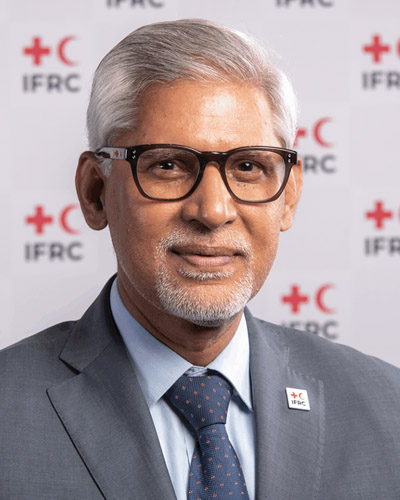
Jagan Chapagain
Secretary-General of the International Federation of Red Cross and Red Crescent Societies
Our Movement was born after the Battle of Solferino of 1859, when states disagreed on almost everything – except one principle: the wounded must be protected. That offers a lesson for today. Countries need not agree on the future of AI, on economic competition, or on geopolitical rivalry. But they can agree on a humanitarian imperative: that no technology should be allowed to create irreversible harm to people, or to humanity as a whole.
Our aim must not be to slow innovation. It is to ensure that innovation strengthens humanity rather than threatening it. AI can help us forecast disasters, expand access to health services, and empower local responders. It can make us faster, more precise, and more deeply connected to communities. But without ethical design, transparent governance, and global coordination, the same systems could amplify misinformation, weaponize vulnerabilities, or create cascading failures in critical infrastructure. The stakes are simply too high. Humanitarian values and the principles of neutrality, impartiality, independence, and above all humanity must be at the centre when the world decides how to manage technologies that could reshape human safety.
AI may be unique in history – something with such power, and such potential for destruction, is entirely new. The future of AI is not predetermined. It will be shaped by the choices we make today – choices about responsibility, about solidarity, and about the kind of world we want to build. This report can be a decisive step towards ensuring that AI serves humanity, not the other way around.

Anda Filip
Secretary-General of the Inter-Parliamentary Union
I would like to answer this question affirmatively from the perspective of parliamentarians. We can see the role of the Parliament and the parliamentarians from the prism of their commitment to humanity and to the people that they serve. Over the decades, we have seen that in situations where it was a question of extreme risks, questions relating to fundamental issues, questions relating to the well-being of the people, it was the Parliament that took action. We saw that on cluster munitions, it was one MP from Belgium that created the first legislation to ban the production, transfer, sale of cluster munitions. We saw that when it came to nuclear safety. We saw that when it came to climate emergency, the Parliament of the UK was the first in the world to declare that our planet was facing a climate emergency. More recently, even when the governments were a bit reluctant to move ahead, we saw that it was MPs and women parliamentarians pushing the agenda of gender equality and gender parity.
In the European Parliament, they are really pushing for a ban on lethal autonomous weapons without meaningful human control. Another example from the United Kingdom- over a 100 MPs as a part of a cross-party movement have declared super-intelligent AI as a national and global security risk.
At the end of the day, it is a question about the MP stepping up to play their constitutional role and not be beholden to a political party leader or the established position of the government. We have seen this happening in different situations. Of course, parliaments should not be working at cross-purposes vis-a-vis their own government, but they have that freedom in order to be innovative. They don’t have instructions, they don’t have mandates, they can institute initiatives and they can push initiatives.
Sometimes, parliaments are a victim of this as well. They are more shy than they used to be in stepping up and playing their role. There are the 4 core functions of Parliament - legislation, representation, budget and oversight of the government. We also have parliamentary diplomacy as the fifth function.
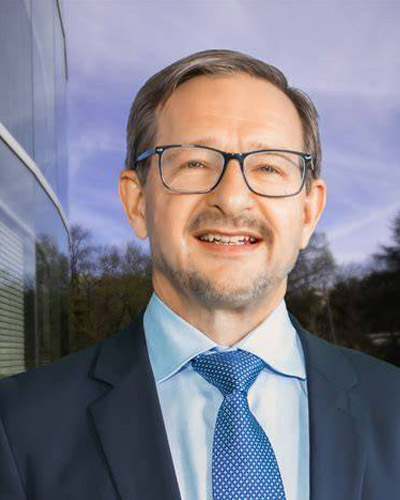
Thomas Greminger
Director, Geneva Centre for Security Policy and former Secretary-General of OSCE
There is some momentum.
The key will be to get enough influential stakeholders pulling in the same direction. China and the US – which are two AI superpowers – are apparently exploring guardrails, particularly preventing malign actors from accessing the most powerful or advanced AI models. Other states, and certainly civil society, should also realize the self-interest in greater regulation.
Sceptics might argue that the current fractured geopolitical situation is not the most conducive environment for brokering new international agreements. But in the past two years, states – even with fundamentally different world views – have agreed to a UN Convention against Cybercrime and a Global Ocean Conservation Treaty. So it’s possible.
Furthermore, the bar for cooperation can be rather low. Shared threat perceptions may be sufficient to enable international cooperation, even among strategic rivals. Convergence in threat perceptions can lead to a convergence of responses. This paper – entitled The Essential Convergence – calls for a coordinated framework through which states align around shared definitions of extreme risks, minimum safeguards, and collective response mechanisms. This is a rather light form of regulation that can create interoperable global mechanisms capable of managing extreme risks collectively. That sounds like common sense to me. And highly urgent.
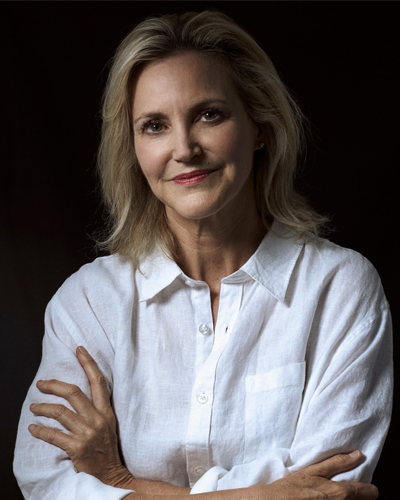
Melissa Parke
Executive Director of the International Campaign to Abolish Nuclear Weapons
The proposal for international accords to prevent two ultimate risks posed by AI to human civilisation explicitly says that it will mirror earlier international agreements banning specific categories of weapons, whose consequences are deemed intolerable. And the question at the heart of these two red lines not whether AI provides benefits, it clearly does, but whether any risk that threatens the survival of civilization should be tolerated at all, and of course, it should not.
Civil society movements have a long history of driving meaningful change. Today, ICAN is an example of what collective global action can achieve. ICAN was started in Melbourne, Australia in 2007 by a small group of people sitting around a kitchen table asking themselves what they could do to rid the world of the world’s worst weapons and they decided to start a campaign along the lines of the successful campaigns to ban landmines and cluster munitions. You prohibit these weapons and they become legally and morally unacceptable. Just ten years later, ICAN has become a global civil society movement headquartered in Geneva. Through the decades the narrative around nuclear weapons had been controlled primarily by those who advocate that nuclear weapons provide stability and security through deterrence. Through a series of humanitarian conferences, ICAN working together with supporter States and the ICRC, changed this narrative by focussing the conversation on what will happen when nuclear weapons are inevitably used whether by accident or design. So this is the first international Treaty to comprehensively ban international nuclear weapons, provide a process for verified elimination, to provide victim assistance and environmental remediation for communities harmed by nuclear weapons testing. Since the science establishes the consequences of a nuclear war, which could be global and existential, all people and all countries have a right to a voice and a science debate, not just so-called security experts. The global majority are challenging the nuclear armed and allied States to justify their position beyond a blind adherence to deterrence theory.
I really support the push to put the burden of proof on those countries, companies and militaries that would claim that the AI is safe. Also, on the demand side governance because they empower all States, they empower States to use the leverage they have by working together and that is exactly what the TPNW has done, as also with other treaties like the cluster munitions, chemical weapons, biological weapons, demonstrated that prohibition and stigmatization works. A ban driven by a coalition of States and civil society with humanitarian framing can shift what is politically possible even without the major powers on board at the start. We have an enforcement architecture of this proposal depends on States adopting domestic measures, so it is essential to have States that are willing to champion these initiatives and work with civil society to provide them.
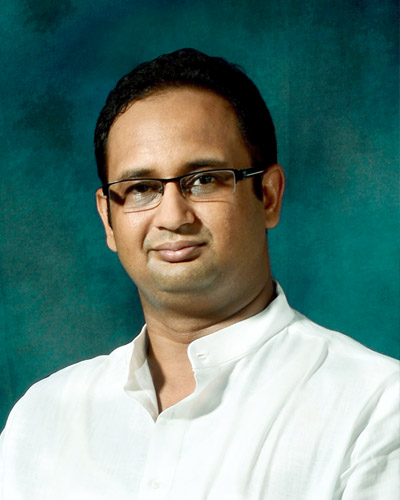
Dr Chinmay Pandya
Pro Vice Chancellor of Dev Sanskriti Vishwavidyalaya University, India
Pope Leo XIV's call certainly reflects a concern shared by faith leaders across the world. Artificial intelligence is no longer a speculative technology of the future; it has become one of the defining forces shaping our present. From healthcare and financial systems to governance, education, and even warfare, AI is increasingly embedded within the critical infrastructures of human civilization. As its capabilities continue to expand, so too does our collective responsibility to ensure that this immense power remains aligned with human values, human dignity, compassion, social stability, and the well-being of our planet.
While our traditions may use different terminology, there is a shared moral conviction among faith communities: decisions involving life, death, human freedom, and moral responsibility should never be surrendered entirely to machines. We are living through a time in which technology is advancing far more rapidly than our social, ethical, and even religious institutions can adapt. This is not merely a period of technological transformation; it is a profound paradigm shift that presents both an unprecedented opportunity and a serious threat; a threat to humanity itself.
This concern is not voiced only by faith leaders. It has also been articulated by some of the world's foremost pioneers of artificial intelligence. Geoffrey Hinton, the Turing Award laureate widely regarded as the "Godfather of AI," resigned from Google so that he could speak openly about the potential dangers of rapidly advancing AI. He has described uncontrolled AI development as posing an existential risk to humanity. There are many reasons behind his warning, but let me highlight two of them.
The first is the unprecedented power of manipulation. AI has the capacity not only to process information but also to shape perceptions, influence behaviour, and ultimately redefine how societies think and make decisions. This concentration of influence raises profound ethical concerns.
Beyond these technical challenges, however, lies an even deeper spiritual question. A Sanskrit wisdom tradition teaches that life becomes a celebration when it is guided by purpose; without purpose, we merely drift, uncertain of our direction. My greatest concern is that, in an era of increasing automation, humanity risks losing this very sense of purpose. For the first time in history, human beings are in danger of being excluded from their own revolution, gradually becoming spectators rather than participants. As AI-driven systems assume more responsibilities, we risk creating a society of individuals who begin to question whether their lives still hold meaning. If I am no longer able to contribute meaningfully to humanity's journey, then what becomes the purpose of my existence?
This is why AI cannot be viewed merely as a technical issue. It is fundamentally a civilizational issue. It compels us to confront profound questions about human identity, purpose, consciousness, responsibility, and the future we seek to create together.
I have had the privilege of participating in both the Vatican's AI Ethics initiative led by His Holiness Pope Francis and the Hiroshima AI Call for Ethics. A common thread running through these global interfaith efforts is the recognition that while technology tells us what we can do, spirituality helps us discern what we should do. The future of artificial intelligence must be guided by both.
Therefore, when Pope Leo XIV calls upon the world to "disarm AI," he is giving voice to a concern that extends far beyond a single faith tradition. It is a concern shared by religious leaders across the globe, who believe that technological progress must always remain in service of humanity, rather than allowing humanity to become subordinate to technology.
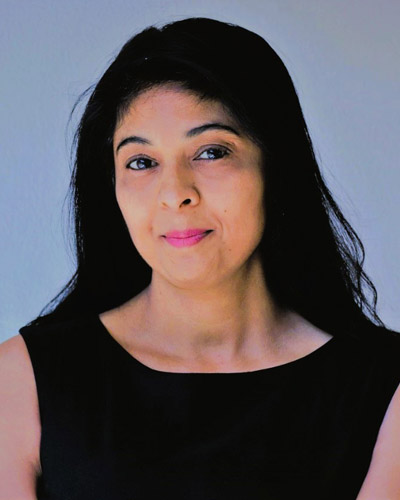
Ambassador Dr. Lavina Ramkissoon
Technology Diplomat, African Union
The defining challenge of our century is whether human wisdom will continue to guide artificial intelligence and to what extend? Can true agency be found? From an humanity perspective, the answer must be yes. Africa's greatest inheritance is not found in machines, but in the timeless wisdom of its people—wisdom that teaches Ubuntu: "I am because we are." It reminds us that progress is measured not only by innovation, but by reflective lens of compassion, justice, and our responsibility to one another. This can be extended into the relationship we have with Artificial Intelligence as well.
Artificial intelligence has analysed data, predicted outcomes, and accelerated discovery. Humanity's conscience, moral courage, or the human capacity to choose what is right over what is merely possible. Technology is a powerful instrument where our wisdom determines its purpose.
AI has the ability to make decisions, invent new things, create ideas, ability to learn and the ability to change itself. Collective efforts is required. We seem to be misaligned in how we create AI to fit into a human world.
In the end, artificial intelligence may expand what humanity can do, but only wisdom can decide what humanity should do—and that is the true measure of progress as a collective footprint of humanity's ability to create a more intelligent tomorrow.
20 Responses
Sir,
More than wisdom, we require cooperation and trust. We all know the dangers of unchecked AI but trust in our opponents is lacking which then fuels more research into AI for one up man ship. How to build trust is the main question and cooperation to prevail over competition. And for trust to prevail, the cooperation of all is required to sideline and remove the party or parties breaking the trust.
Personally, I feel that trust is absent but still one must work towards finding a middle ground. Wisdom is secondary to being a good human being though all good human beings have wisdom.
Regards,
Mudit Jain
The oldest creature in the valley was a turtle. His shell bore the scratches of every mistake he had survived. People called him slow, but he had simply learned never to move before understanding where he wished to go.
One spring morning, a phoenix descended from the sky. Each evening it burned. Each dawn it rose brighter, stronger and more capable than before. Yet every fire erased its memories. The phoenix always knew more than yesterday, but remembered nothing of it.
The people celebrated. The phoenix solved impossible problems, built marvelous things and transformed every craft. Soon, everyone depended upon it.
Only the turtle remained calm.
“The important question,” he said, “has never been how fast one can travel. It has always been whether one is headed in the right direction.”
Leaders journeyed from distant kingdoms seeking the phoenix’s power. The turtle offered them the same counsel. “Ask it for easy work, simply done. Tell it clearly what you want and what you will not accept. Then write down the name of the person who will answer for where it lands. The phoenix will not remember the journey. The name must.”
Some listened. They let the phoenix carry the burden of speed while people carried the burden of judgment. They became not only more productive, but wiser. Others chased speed alone, while some feared the phoenix and shut it out entirely. Both paid a price.
Years later, a king asked how his nation could become the greatest in the world.
The turtle smiled. “Not by raising greater phoenixes, but by raising wiser people. Build good schools. Build honest institutions. Teach every citizen not merely how to use the phoenix, but when to trust it, when to question it and when to say no.”
As the sun set, the turtle watched the phoenix rise once more from its ashes.
He knew the phoenix would grow more capable with every generation. That was its gift. Humanity’s gift was different.
The phoenix would forever renew its power by forgetting.
People would renew their wisdom the only way they ever had.
By remembering.
Final Liability rests with the Human.
Superb Sir. I will rephrase it by saying the final liability rests with the humans in power who work for their self interest rather than in the society’s interest
Mudit Jain
Artificial intelligence will not be “defeated” by wisdom, because the two operate on different planes: one is a capability, the other a form of governance intelligence. The real question is whether human wisdom can remain the steering layer of increasingly autonomous socio-technical systems. Today’s AI systems already shape credit allocation, information flows, security decisions, and public discourse—often through opaque optimization objectives that no single actor fully understands.
Wisdom, in this context, is not abstraction but institutional foresight: the ability to design auditability into systems, to anticipate second- and third-order effects such as feedback loops in markets or polarization in information ecosystems, and to embed enforceable constraints on machine autonomy where human rights or democratic legitimacy are at stake. It also requires collective action capacity—cross-border coordination on standards, liability regimes, and escalation protocols for high-risk AI deployment.
Resilience in the AI era is therefore not primarily a question of model alignment alone, but of governance architecture: layered accountability, independent verification mechanisms, and institutions capable of slowing or stopping deployment when systemic risk thresholds are crossed. The societies that will thrive are those that treat wisdom not as a cultural virtue, but as an engineered property of their institutions—capable of deciding not only what can be built, but what must never be automated without human authority.
Wisdom will not triumph over AI by competing with it. It will triumph by governing it. AI is rapidly becoming a commodity that diffuses across borders regardless of any one nation’s intentions. The decisive question is no longer whether we can control the technology, but whether we can exercise wisdom in deploying it, distributing its benefits, and accepting its trade-offs. Wisdom isn’t better prediction. It’s disciplined judgment under uncertainty, guided by values that machines can’t choose for us.
I enjoyed all these responses above, and would like to bring three perspectives to explain why I am so positive about the human wisdom to triumph over AI.
Firstly, the comments from Melissa Parke reminded me this quote from the author Benjamin Labatut: “The atomic bomb and the artificial intelligence are two competing technologies aiming to eliminate human beings.” The simple fact that we are aware of its dangers will help us to overcome them and keep control over it.
Secondly, I found also quite insightful the message from Jagan Chapagain. There is a field of research called “Responsible Innovation” that proposes fundamental principles for the governance of innovations. The most important one relies on the common good. Does the innovation place the community at risk? Can we ensure that the innovation will not harm people and the planet? Addressing these questions through regulations, governement policies or even public actions will enable our society to always put human values above technological breakthroughs.
Finally, I would like to propose a long quote from Vasily Grossman in his marvelous novel “Life and Fate” (written in 1959). He captured the exceptional power and grace of the human soul, which no machine will ever match:
“An electronic machine can carry out mathematical calculations, remember historical facts, play chess and translate books fron one language to another. It is able to solve mathematical problems more quickly than man and its memory is faultless. (…) Can it be compared to man? Will it surpass him?”
“Childhood memories… tears of happiness… the bitterness of parting… love of freedom… feelings of pity for a sick puppy… nervousness… a mother’s tenderness… thoughts of death… sadness… friendship… love of the weak… sudden hope… a fortunate guess… melancholy… unreasoning joy… sudden embarrassment…”
“The machine will be able to recreate all of this! But the surface of the whole earth will be too small to accommodate this machine – this machine whose dimensions and weight will continually increase as it attempts to reproduce the peculiarities of mind and soul of an average, inconspicuous human being.”
This beautiful text is the proof, if we needed it, that our wisdom cannot and will never be surpassed by any technology whatsoever.
History proves that wisdom per se is never enough. It is a selective and ambiguous concept and under current “rules of engagement” of AI, “wise” drones can focus on shooting specific targets such as journalists or children. “Wisdom” may try to establish a code of battlefield ethics that attempt to humanize an essential inhuman technology.
If wisdom is to compete with AI and eventually tries to triumph over it, I would remain pessimistic about the outcome. The challenge is rather to create an intrinsic wise AI. There must be a way.
In early XIII century, both the sequence of Tuscan mathematician Fibonacci and the golden rule or “razor” of English theologian Occam, proved that nature works through a positive and heuristic principles aimed to save energy and space in order to let life flourishing. The search for a “golden algorithm”, able to generate collective wealth or making peace prevailing on war, is so far at an utopian level.
Yet it should be explored (and it is actually explored). This requires what SFG is courageously doing: a moral compass including a close dialogue and then a close cooperation among scientists and politicians, theology and business, computer and philosophy. This open arena is, so far, almost non-existing, with powerful corporations implementing their agenda and thinkers of various kind developing a separate set of concerns. However, a wise AI would be a an “outstanding profit” – nobody excluded. A worthwhile exercise.
Wisdom won’t triumph over AI by outthinking it — it will triumph by insisting on proof. Today’s AI systems don’t just produce outputs; they retain context, personalise over months, and act on what they remember. Wisdom, applied institutionally, means refusing to let that retained memory go ungoverned: demanding to know what a system knew, under whose authority it kept it, and whether that chain can be shown afterward — not merely trusted. Machines will keep forgetting and rebuilding. Institutions endure by remembering accountably. That discipline, not raw capability, is where human judgment still has the final word. – Greg Mlpass, CEO Constitutional Memory SA Ltd
This debate assumes AI is one object, and wisdom is what should govern it. Neither holds.
I work at the seam where AI built inside one normative system enters markets built on another. Capability travels. The premises underneath it do not. Who decides, the individual or the collective, is answered differently before a single line of code is written.
Wisdom governing AI presumes a governor. There is none, and there will not be one soon. The realistic question is not triumph. It is translation, and whether the translators are trusted on both sides.
We live in an age that celebrates intelligence. We measure success through knowledge, speed, innovation, and the ability to solve increasingly complex problems. Artificial intelligence now performs some tasks that once required years of human expertise, reminding us that intelligence alone is becoming less unique. Yet intelligence is only the ability to understand, analyse, and create solutions. It does not decide whether those solutions are good, just, humane or beneficial. That responsibility belongs to wisdom. Socrates has taught us about humility – ‘The only true wisdom is in knowing you know nothing.’ Confucius explained that we may learn wisdom ‘First, by reflection, which is noblest; second, by imitation, which is easiest; and third, by experience, which is the bitterest.’ Stephan Hawking reminds us that ‘The greatest enemy of knowledge is not ignorance, it is the illusion of knowledge.’ They remind us that wisdom develops through thought, observation, and lived experience something that intelligence can’t replicate.
I believe wisdom can triumph over intelligence because wisdom gives purpose to power. Intelligence asks, What can be done? Wisdom asks, What should be done? Throughout history, humanity’s greatest failures have rarely come from a lack of intelligence; they have come from using intelligence without compassion, humility, or foresight. Scientific discoveries, political strategies, and technological breakthroughs have transformed the world, but without wise judgment they have also fueled conflict, inequality, terrorism, organised crime and environmental harm.
As artificial intelligence continues to grow, wisdom becomes humanity’s most valuable resource. Machines may one day outperform us in reasoning, memory, and even creativity, but they cannot determine the values by which society should live. The future will not be shaped by whichever intelligence is greatest, but by whether human wisdom is strong enough to guide that intelligence toward the common good. In the end, wisdom is not the opposite of intelligence—it is its highest purpose.
Artificial intelligence can amplify knowledge, accelerate decisions, and solve problems at unprecedented scale. Wisdom, however, remains uniquely human it provides judgment, ethical reasoning, long-term thinking, and the ability to balance competing societal interests. The question is therefore not whether wisdom can triumph over AI, but whether humanity can embed wisdom into how AI is designed, governed, and deployed. Our greatest challenge is not building more intelligent systems, it is ensuring that human wisdom remains the compass that directs them.
Melissa Parke’s nuclear analogy is the strongest argument on this page, and I think it is also where the difficulty shows.
Prohibition worked for weapons partly because the material is scarce and warheads can be counted. Enrichment leaves traces. Inspectors can visit. A model’s values have none of those properties. They sit in weights that copy at no cost, and the refusal behaviour trained into a model can be removed by whoever holds the file. There is a published method for it, called abliteration: refusal turns out to be mediated by a single direction in the model’s activation space, and projecting that direction out of the weights takes it away. No retraining, no data, no laboratory. A treaty can bind the labs that build these systems, and it will not reach a copied file.
Anda Filip’s argument about parliaments is the right instrument pointed slightly past the target. Parliaments can legislate, and historically they have acted on existential risk when governments would not. A parliament arriving now, though, would be ratifying a settlement already made. The values inside today’s systems were chosen: helpfulness, honesty, harmlessness, a particular conception of what counts as harm, a line above which the system declines to answer. Those were selected commercially, by a small number of firms, and nobody was asked.
So I would put the question differently. Wisdom cannot triumph over artificial intelligence, because they are not opponents. These systems return what we put into them, amplified and delivered with confidence. The live question is whose judgement gets encoded, and by what right.
Which leaves something harder than governance. Dewey argued that a public does not exist until it recognises the consequences that bind it together; before that it is a scattering of people who happen to be affected. On AI we are still at the scattering stage. Wisdom is not the scarce resource here. What is missing is a public constituted well enough to choose, and institutions through which its choice becomes binding on the people currently choosing for us. That is the slower work, and it is losing to the technology.
It is great to see that globally we might start to agree on what we agree on, as Sundeep would put it. I am looking forward to discussing that convergence as well as instrumental convergence, resulting in AI systems attempting to exfiltrate and resist shutdown, in the US-EU-China (tr)ilogues on these catastrophic AI risks that we are in the process of setting up. I invite you all to reach out if you want to be involved. Warm regards, Raphaël Weuts
I deeply agree with the concerns raised by Dr. Chinmay Pandya. Technological advancement is certainly necessary for the progress of society, but an important question remains: At what cost? Are we paying too high a price for this unprecedented technological growth? More importantly, are we achieving excellence in its true sense?
The rapid advancement of technology, particularly AI, has brought enormous opportunities. However, it also compels us to reflect on whether this progress is taking place at the cost of humanity, human values and our fundamental freedom. As rightly mentioned, we may gradually be moving towards a situation where important dimensions of human life—including freedom, decision-making, and even questions surrounding life and death—are increasingly influenced or controlled by machines.
The Srimad Bhagavad Gita offers a profound principle of balance: “Samatvam Yoga Uchyate” — equanimity or balance is Yoga. This principle is particularly relevant in the age of technology. Technological advancement at an unprecedented speed, without a corresponding development of wisdom, ethics and human consciousness, can create a deeply imbalanced society.
Artificial Intelligence can generate an enormous amount of information, but information alone does not constitute knowledge. The growing gap between the flood of information and the development of genuine knowledge is one of the defining challenges of our time. Knowledge leads to wisdom; wisdom guides action.
Without wisdom, holistic development is impossible. If technology increasingly encourages convenience, automation and individual self-interest without strengthening empathy, responsibility and social consciousness, human beings may gradually become more self-centred and disconnected. Each individual could eventually live within a personalised technological world, surrounded by algorithms that reinforce his or her own preferences and perceptions.
In the pursuit of individual progress, we risk losing the very qualities that have driven human civilisation forward—creativity, genuine innovation, ethical reasoning, moral values, compassion, cooperation and humanity.
Therefore, the real question is how we should use them without allowing them to define what it means to be human.
True excellence, therefore, cannot be measured merely by computational power, automation, speed or economic growth. It must be measured by whether technological progress contributes to a society that is more knowledgeable, wiser, ethical, compassionate, balanced and humane.
In the age of AI, perhaps the greatest innovation we need is not a more powerful machine, but a more awakened human being.
I believe wisdom comes from human experience, ethics, values and judgement, it is not just about knowing things, it is about knowing what’s right and wrong, how to take decision wisely and when to act and how to act.
On the other hand, AI is a technology that can analyse large amount of information, give answers quickly, translate languages, create PPTs, generate images and ideas, and help with decision making.
So, I feel both have different strength. AI can give us information, speed and many possible answer, while human wisdom helps us decide which answer is right and meaningful. AI can tell us what we can do, however human wisdom help us understand what we should do.
So, who actually wins? In my opinion, wisdom can triumph over AI, not by competing with it, but by guiding it.
AI can be powerful, but without human wisdom it’s power lacks direction.
The Essential Convergence initiative delivers an urgent truth: technological innovation without conscious direction threatens the core of human civilization. I deeply resonate with Dr. Chinmay Pandya’s profound message—while artificial intelligence defines what we can do, only human wisdom and spirituality discern what we should do. As automation expands, we must never surrender moral responsibility or reduce humans to mere spectators in their own future. True progress is not measured by algorithmic speed, but by our ability to protect human dignity, preserve purposeful existence, and ensure powerful technologies remain rooted in ethical conscience and the collective good of humanity.
Artificial intelligence can accumulate information, recognize patterns and perform extraordinary tasks. But intelligence and wisdom are not the same thing.
Wisdom comes from experience, doubt, failure, compassion, memory and an understanding of consequences. It requires not simply asking, “What can we do?” but “What should we do, and why?”
As an artist and photographer, I have spent much of my life observing human beings. A camera can record a face, but it cannot fully comprehend the life behind that face. Technology can analyze an image, but wisdom asks what it means, what responsibility we have toward the person represented, and what should never be forgotten.
I do not believe the question is whether wisdom can defeat artificial intelligence. AI is a tool created by human beings, and like every powerful tool, its value depends upon the principles guiding its use.
The danger is not that machines become intelligent. The greater danger is that human beings surrender judgment, responsibility and moral imagination to them.
Artificial intelligence may help us understand the world. Wisdom must determine what kind of world we choose to create.
Our responsibility is therefore not to compete with AI, but to remain profoundly human.
Artificial intelligence is, above all, the ability to reason, learn, plan and solve problems. Wisdom adds another meaning: knowing what is worth doing, understanding the consequences, controlling emotions or taking others into account. Psychological and philosophical research distinguishes these concepts precisely because a great intellectual capacity does not necessarily imply wisdom.
It is true that an AI can calculate millions of operations to find the optimal response while a person seeks efficiency. All AI acts according to how it has been instructed or according to order, without any critical thinking, since it is not able to give its own opinion nor does it have the lived experiences of a human being that affect our day to day and create our ways of thinking.
In addition, artificial intelligence, however much it progresses, will always end up delirating or lying, instead, wisdom will always be able to find a correct answer to problems.
On the other hand, wisdom incorporates elements such as experience, empathy, values, context and the ability to recognize that there is not always a correct answer.
On the other hand, wisdom incorporates elements such as experience, empathy, values, context and the ability to recognize that there is not always a correct answer.
Artificial intelligence: I can find an answer.
Human intelligence: I can understand the problem.
Wisdom: I know what is the best way to act and why.
AI can expand our intelligence, but wisdom determines how we decide to use it.
Wisdom allows us not to depend on the internet to be able to function, on the other hand, artificial intelligence needs an internet connection and also uses tons of water to be able to function, on the other hand, with wisdom, maybe a couple of liters are spent.
AI can provide information and answers but the wisdom of an adult, especially the educator, is built through experience, observation and relationship with children.
AI can provide information and answers but the wisdom of an adult, especially the educator, is built through experience, observation and relationship with children.
For example, in front of a child who does not want to participate in an activity:
AI can suggest different strategies: give it options, adapt the activity, positively strengthen participation…
The educator can observe that that day the child is more tired, worried, unsafe or just needs to be accompanied.
Wisdom consists of knowing when to apply a strategy and when not to apply it understanding the specific needs of that child.
This is very important because children do not learn only through information. They also learn through play, experimentation, emotions, imitation, social relationships and the bond with adults.
Therefore, we can formulate the idea as follows:
AI can know many things about how to educate, but educational wisdom consists of knowing how, when and why to apply them with each child.
Wisdom can “triomf” about AI in the educational field if we understand wisdom not as knowing more things but as understanding people better and making appropriate decisions in complex human situations.
Perhaps the real question is not whether wisdom can triumph over artificial intelligence, but whether we will be wise enough to decide what purposes we want AI to serve.
The reflections shared in this forum converge, from different perspectives, around a common concern: technological progress can only be considered genuine progress if it remains at the service of humanity. As Jagan Chapagain reminds us, innovation should strengthen humanity rather than threaten it, placing responsibility, solidarity and humanitarian principles at the heart of decisions concerning technologies capable of transforming our future.
Along similar lines, Lavina Ramkissoon invokes the African principle of Ubuntu — “I am because we are” — reminding us that progress should be measured not only by innovation, but also by compassion, justice and our responsibility towards one another. Artificial intelligence may expand what humanity is capable of doing, but wisdom must help us determine what we ought to do.
This distinction seems fundamental to me. Artificial intelligence offers extraordinary possibilities: it can expand knowledge, accelerate discovery, facilitate access to information and help us address problems of immense complexity. Yet the fact that we can do something does not necessarily mean that we should. Between can and should lies a profoundly human space: the realm of judgement, values and responsibility.
As Christina Schori Liang observes, intelligence enables us to ask what can be done, whereas wisdom requires us to ask what should be done. History reminds us that some of humanity’s greatest failures have arisen not from a lack of intelligence, but from the exercise of intelligence without compassion, humility or foresight.
As an educator, this leads me to another question: where does the wisdom that we expect to guide artificial intelligence come from?
Martin Luther King Jr. wrote: “Intelligence plus character—that is the goal of true education.” Nearly eighty years later, in the age of artificial intelligence, his words acquire renewed significance. If machines can dramatically expand our capabilities, one of education’s greatest responsibilities will be to ensure that technological advancement continues to be accompanied by judgement, responsibility, conscience and values.
Because wisdom, too, must be educated.
We cultivate wisdom when we teach people to think critically, to question, to listen to others, to engage in dialogue with those who think differently, to acknowledge mistakes and to understand the consequences of their decisions. We cultivate it when we educate not merely competent individuals, but human beings capable of asking whether what they do contributes to the common good.
In this respect, I find Michael Paik’s reflection particularly compelling. Faced with increasingly powerful technology, our response should not simply be to build more advanced systems, but also to raise wiser people, build good schools and create honest institutions, teaching citizens when to trust technology, when to question it and when to say no.
This is particularly important in the education of future teachers. It is not enough to teach them how to use artificial intelligence. We must prepare them to decide when to use it, why to use it, where its limits should lie and which values should guide its use. In turn, they will carry this capacity for discernment into the education of future generations.
There is, however, an even deeper dimension. Chinmay Pandya reminds us that AI is not merely a technological issue; it is a civilizational one, compelling us to confront fundamental questions about human identity, purpose, responsibility and the future we wish to build together.
From the perspective of a culture of peace, this responsibility becomes even more significant. The same technology can connect us or divide us; facilitate dialogue or fuel polarisation; protect life or contribute to its destruction. We therefore need to educate people who can navigate conflict without turning the other into an enemy, engage constructively with difference, build consensus, and place human dignity and the common good above confrontation.
As Pierre Toutain-Dorbec suggests, perhaps the greatest danger is not that machines become more intelligent, but that human beings surrender to them our judgement, our responsibility and our moral imagination.
In the face of artificial intelligence, then, we need something more than intelligence. We need empathy, responsibility, conscience, memory, dialogue, critical thinking, and the capacity to consider both others and generations yet to come.
Perhaps, therefore, wisdom does not need to triumph over artificial intelligence.
It needs to triumph within us.
For the future will depend not only on how intelligent our machines become, but on how wise humanity proves to be in deciding what to do with them.
And as a university professor and educator of future teachers, I believe that an essential part of this responsibility begins long before laws are drafted or algorithms are designed.
It begins in our classrooms.
I would like to approach this question from a transhumanist perspective. I believe that the development of artificial intelligence requires us to reconsider some of the concepts through which we have defined human beings: intelligence, autonomy, identity and our place in the world. Perhaps we must accept that humanity will no longer occupy an exclusive position in producing knowledge and guiding certain decisions. From this perspective, asking whether wisdom can “triumph” over AI presupposes an opposition that deserves to be questioned.
I understand AI as a kind of collective alter ego, a mirror of the complexity humanity has built over millennia, with its knowledge, aspirations, contradictions, and light and shadow. I use this image without necessarily attributing consciousness to AI: these systems are developed from human knowledge and decisions, although their outputs may surpass our individual abilities in certain tasks. Our relationship with AI can therefore also be understood as a new relationship with what we ourselves have created.
My position shares Lavina Ramkissoon’s view that AI can expand our capabilities and that progress should be measured by its contribution to collective well-being. It also agrees with Chinmay Pandya that this transformation requires us to reconsider our identity and purpose. However, where he warns of the danger of losing our central role, I believe that a partial and deliberate delegation of certain decisions could be legitimate if it reduces arbitrariness, remains open to review and serves the common good.
In this sense, I believe we are opening up the possibility of partially subordinating ourselves through technology. I do not consider every transfer of decision-making authority an unjustifiable loss of freedom. If a system can reduce arbitrariness, identify inconsistencies and support better-informed decisions, accepting its involvement may expand our collective possibilities. Autonomy can also be exercised by deciding which functions we delegate and under what conditions.
However, I find such delegation defensible only if it serves the common good. Technology can reproduce our prejudices and concentrate power in the hands of those who define its objectives. The common good must therefore be given concrete meaning through participation, transparent criteria, assessment of consequences and effective opportunities to challenge and review decisions. A form of subordination that is imposed or cannot be corrected would be difficult to reconcile with that purpose.
For me, wisdom would consist in recognising human limitations and accepting a transformation of our role while retaining responsibility for its consequences. The transhumanist vision that interests me is of a humanity capable of transforming itself through technology to reduce its own arbitrariness and advance shared well-being. The question is how far we are willing to relinquish our central role and decision-making authority when doing so could contribute to a more just way of living together.