
The Essential Convergence at the House of Lords
The Essential Convergence report was discussed at the House of Lords in London on 10 September 2026 in a meeting hosted by Rt Hon Lord Alderdice. Members of the House of Lords, alongside scholars from Oxford and Cambridge Universities commented on the key recommendations of the report. The overwhelming sense in the room was that the United Kingdom has an opportunity to facilitate convergence between major AI powers because of its high technical expertise. Keynote speakers included Anda Filip, Secretary General of the Inter-Parliamentary Union and Sundeep Waslekar, President of Strategic Foresight Group.
Lord Alderdice said that we are living in the most dangerous phase in history and damage caused now cannot be repaired within our lifetimes. Sundeep Waslekar presented the key elements of the report and stressed on the role that parliamentarians can play in bringing about AI safety. Anda Filip spoke about the need to bring about AI literacy among parliamentarians and the need to address extreme AI risks. She said that that the national security establishment within countries could be tapped, but parliamentarians need to question the governments approach to AI risks. There are already more than 70 Parliaments that have looked at AI. IPU has addressed these issues through their resolutions. She stressed on parliamentary diplomacy and the role that they have played in nuclear weapons, landmine and cluster munition ban.
Dr Sam Daws of Oxford Martin AI Governance Initiative at University of Oxford said that AI is hard to govern because it is an opaque technology. UK has the potential for leadership because of its AI safety institute. There is a real danger of AI attacks on UK infrastructure. Agentic AI can deceive and collaborate. The routes to AGI are different. New risks may emerge when AI is used in smart cities. He also focused on the links between AI and biological weapons.
Dr Henry Shevlin, Co-director of Education at the Leverhume Centre for the Future of Intelligence, Cambridge University, said that he was more optimistic about AI, though the risks are very real. UK is in a good position to take a lead on AI Safety. It has the second largest number of startups in the world. He said that the Essential Convergence report was realistic as to the risks and appreciated the solutions given such as procurement rules, insurance mechanisms. He said that the degree of oversight was important. Compute power is not the way ahead as a reasonable threshold today may not be valid one year later. He suggested that the report add whistle blowing mechanisms or hotlines for agentic AI.
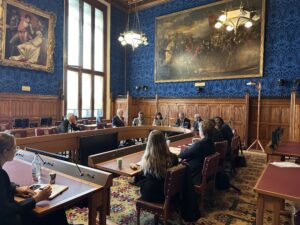
Baroness Helic questioned why there was no public outrage when there is such a big risk from AI towards human extinction. A recent report said that it was 10 per cent in the next decade. Lord Alderdice responded that large groups operate on feelings rather than rational considerations.
Professor Robert Trager, Director of the Oxford Martin AI Governance Initiative said that technical verification is very critical, but no one is doing it. Some things are more engineering problems than scientific ones. As Finland took a lead in abolishing chemical weapons and Sweden did on seismology, UK can take a lead in AI safety and governance.
There was a discussion among participants about the very definition of intelligence and the question of culture and language in the training of LLMs.
Anda Filip concluded by saying that there is a need to listen to young people and to measure the impact of AI on social justice and inequality. She said that there is a need to speak with academics and bring about ethical ad compassionate leadership.
In brief, the discussion concluded that the United Kingdom is well placed to lead internationally, particularly through its AI Safety Institute. Participants called for ethical leadership, engagement with young people, along with a focus on extreme risks in the future development of AI.