
2 July 2026
Sakal Media Group, AP Globale, and the Consulate General of Switzerland hosted the launch of a book by Sundeep Waslekar- Beyond the Hype: Many Realities of AI, at the Royal Opera House, Mumbai on 2 July 2026. The book has been published by Sakal Media Group in English as well as in Marathi.
On this occasion, Ambassador Pankaj Saran, former Deputy National Security Advisor to the Prime Minister of India, and currently on the National Security Advisory Board of the Government of India and Swiss Consul General Martin Maier delivered keynote addresses. Ms Janhavi Pawar, Director of Sakal Media Group interviewed Mr Jaan Tallinn, co-founder of Skype, in an online interaction. The focus of all three interventions was on harnessing AI for the benefit of humanity, but also mitigating risks posed by this emerging technology to national security, social stability and world peace.
Several prominent citizens attended the launch event, including Mr Prithviraj Chavan, India’s former Minister of Science and Technology and Minister of State in Prime Minister’s Office, Members of the Legislative Assembly of Maharashtra, corporate leaders, eminent theatre personalities and cultural leaders and members of the diplomatic corps.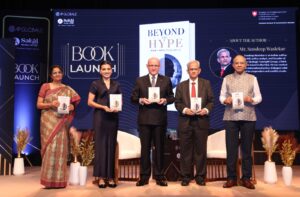
Ambassador Pankaj Saran said that there is no current international framework to govern AI. The problem is that in our euphoria about this new technology, we often ignore some of its downsides. He said, “We are the cusp of a fundamental change in the way that humanity will function. AI has become a powerful tool, a determinant of national power, and which countries will be the guardians of global order. AI can harm humanity in a number of ways- runaway artificial general intelligence, by its use in biological and chemical warfare, by terrorist groups. We are at the cusp of a new battlefield. In old wars, we had International Humanitarian Law, when man fights man. But what happens when man fights machines?”
Swiss Consul General Martin Maier said, “History teaches us that every transformative technology has brought both remarkable opportunities and significant risks. Electricity transformed modern civilisation, yet it also powered destructive weapons. Nuclear technology provides clean energy for millions of people, while simultaneously presenting profound security challenges. Biotechnology has revolutionised medicine yet requires strict safeguards against misuse. Artificial Intelligence is no different. As AI becomes increasingly capable, increasingly autonomous and increasingly integrated into critical systems, our responsibility grows accordingly. We must ensure that Artificial Intelligence continues to remain under meaningful human control. We must prevent its manipulation for purposes that threaten peace, security or human dignity. And we must ensure that innovation proceeds hand in hand with responsibility.”
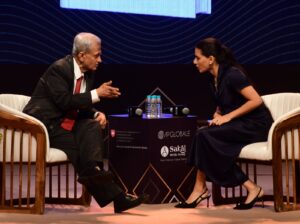 Mr Jaan Tallinn, in the interview with Ms Janhavi Pawar observed that in 2007-2008, in the post-Skype period, he was looking for something interesting to do and he realised that AI was going to be the biggest challenge to humanity. Even Alan Turing wrote in 1956 that eventually machines will be better decision makers than human and that unless we learn how to keep them under control, humanity was at risk. He said, “there is a reason why human civilisation is running this planet, not a chimpanzee civilisation. If scientists and engineers design something that is more intelligent than themselves, it is not implausible that they will lose control.”