
6 July 2026
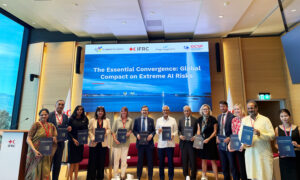
The Launch Event
A new report ‘The Essential Convergence: Global Compact on Extreme AI Risks’ by the Strategic Foresight Group was launched in Geneva on 6 July 2026. The presence of some of the world’s leading AI experts made the launch event memorable. Heads of international organisations including the International Federation of Red Cross, Inter Parliamentary Union, International Campaign to Abolish Nuclear Weapons, ICT4 Peace Foundation, Geneva Centre for Security Policy, Gayatri World Pariwar, and representatives of governments in Africa spoke. They extended their support to implement recommendations of the report.
Keynotes
Jagan Chapagain, Secretary General of the International Federation of Red Cross, said in his opening address: “Humanitarian values and the principles of neutrality, impartiality, independence, and above all humanity must be at the centre when the world decides how to manage technologies that could reshape human safety.”
Thomas Greminger, Director of the Geneva Centre for Security Policy, emphasized the importance of international cooperation in addressing the most serious risks posed by advanced AI. He said in a keynote speech: “The key will be to get enough influential stakeholders pulling in the same direction. China and the US – which are two AI superpowers – are apparently exploring. This report presents a rather light form of regulation that can create interoperable global mechanisms capable of managing extreme risks collectively. That sounds like common sense to me. And highly urgent.”
Sundeep Waslekar, President of Strategic Foresight Group, outlined the parameters of convergence. He said, “Besides the common understanding of the nature of risks, countries can agree on the compute level of 10^26-27 as the threshold level to decide high risk AI models. All countries prefer evaluation before deployment, and they need to explore common standards for deployment and testing. The countries can also agree on maintaining a register of dangerous incidents.”
Panel Discussion moderated by SFG President
In a panel discussion Anda Filip, Secretary General of the Inter-Parliamentary Union, highlighted the role played by Members of Parliament in conceiving and advancing AI regulation. Melissa Parke, Executive Director of the International Campaign to Abolish Nuclear Weapons, explained the processes of arms control treaties that can inspire a global compact on extreme AI risks. Filip said: “In addition to the conventional roles played by the parliaments, we must also shape the concept of parliamentary diplomacy.” Parke noted: “Civil society movements have a long history of driving meaningful change.” Martin Müller, Executive Director of the Geneva Science and Diplomacy Anticipator (GESDA), remarked: “I am sure this approach could also be applied to other technologies because they have risks of their own and you could also possibly build consensus on what the common denominator is and then maybe you build upon those common denominators to have a global agreement.”
Panel Discussion moderated by ICT4Peace Foundation
Anne-Marie Buzatu, Executive Director of ICT4Peace Foundation, moderated a panel discussion involving Chinmay Pandya, Pro Vice Chancellor of Dev Sanskriti Vishwavidyalaya University in India, Lavina Ramkissoon, Co-Chair, AU-ASRIC Council (AI) in the African Union, Derrick Swartz, Science Expert in the Ministry and Department of Science, Technology and Innovation of South Africa, and Kwan Yee Ng, Head of International AI Governance, Concordia AI in China. The panel focussed on the unique feature of this report proposing demand side mechanisms for consumer countries in the Global South. These include leveraging procurement, market size and minerals to bargain fair deals and prevent the import of dangerous AI models.
Christina Schori Liang, a policy adviser at the GCSP and Adjunct Professor at PSIA, Sciences Po, anchored the event.
Link to the full report: The-Essential-Convergence.pdf
Article in Forbes: The U.S. And China Agree On Almost Nothing Except AI’s Deadliest Risks